Emergency Power Supply
Will Your Solar Battery Work During a Power Cut?
One of the most common questions we receive is: “If I install a battery, will my house still have electricity during a power cut?” The answer often surprises homeowners.
Simply installing a battery and inverter does not automatically provide emergency backup power. Many systems can support it, but additional equipment, electrical work and careful design are normally required. Depending on the property, EPS installation can involve as much work as the battery and inverter installation itself, sometimes more.
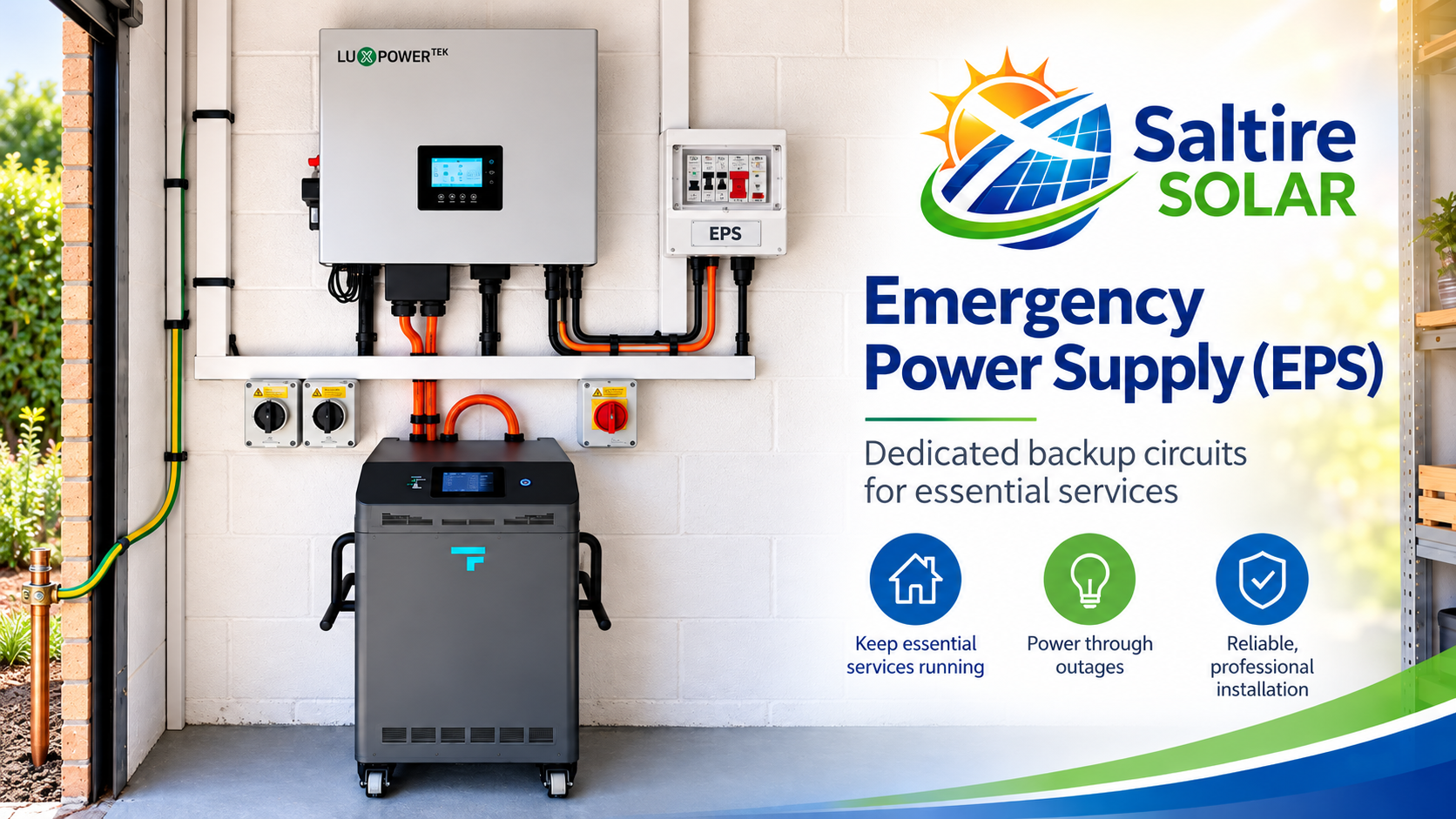
Illustrative artwork. Actual equipment, configuration and earthing arrangements vary by installation.
Understanding EPS
What Happens When the Grid Goes Down?
Emergency Power Supply (EPS) allows a suitably designed battery and inverter to supply your home, or selected circuits, during a power cut.
Normally, the battery works alongside the grid and stores solar energy or electricity bought on a cheaper overnight tariff. When the network fails, an ordinary grid connected inverter must stop feeding the public network for safety. A correctly designed EPS system disconnects suitable equipment from the grid and continues supplying designated parts of the home from stored energy.
Saltire Solar installs Fogstar battery systems with LuxPowerTek inverters, as well as systems from manufacturers such as Sigenergy. Many have backup capability, but EPS must be specifically designed, installed and tested. It is not just a feature to switch on in an app.
Essential Circuits
A Dedicated EPS Consumer Unit
For most existing homes, especially battery retrofits, our preferred approach is a separate EPS consumer unit: a small distribution board supplying selected essential circuits. We normally recommend two or three circuits rather than trying to power every appliance. This focuses backup energy on what matters most.
The exact circuits depend on your property, requirements and battery and inverter capacity. Fridge and freezer backup can help protect food; an internet router can stay powered if your broadband service is still operational. Compatible heating controls, important lights, selected sockets, TV and security systems may also be options.
- Fridge and freezer
- Internet router, if the broadband service is still working
- Compatible central heating controls and pumps
- Essential lighting
- Selected sockets and television
- Compatible security systems
Why EPS Needs More Than a Setting
Existing Electrical Circuits
We inspect the consumer unit, test circuits, check protective devices and identify the current arrangement. Some circuits need alteration, separation or extra cabling before they can safely use backup power.
Battery & Inverter Capacity
Inverters have a maximum backup output; batteries have discharge and storage limits. Even a 32 kWh battery cannot automatically run a shower, oven, EV charger and heat pump together. We assess continuous demand and appliance starting loads.
Earthing & Electrical Safety
Earthing and fault protection must still work when the home disconnects from the grid. Depending on the installation, this may require a suitable local earth electrode, switching equipment and changes to protection. An earth spike alone does not make EPS safe or compliant.
Testing & Commissioning
We inspect and test backup circuits, protective arrangements and changeover operation, including safe operation when disconnected from the grid. These are essential parts of the installation.
Selected Circuits
For many existing properties, a dedicated EPS consumer unit offers a practical way to keep selected services running without placing unnecessary demand on the battery. We assess which circuits can safely move to the backup supply.
Whole House Backup
Whole house backup may be possible depending on the property and equipment. A suitable gateway manages the connection between the grid, battery system and household installation. When the grid fails, it disconnects the property from the network and supplies designated loads.
Whole house does not mean unlimited power. The inverter and battery still set the maximum demand, so electric heating, cooking, EV charging or other high power loads may need to be managed or excluded.
- Gateway and system compatibility must be assessed
- Available backup power remains limited
- The electrical installation must be designed and tested
Gateway Options
Sigenergy SigenStor Backup
Saltire Solar also installs Sigenergy SigenStor battery and inverter systems. For compatible installations, we can separately assess, supply and quote for an optional Sigenergy Gateway.
The gateway manages the transition between the normal grid supply and the battery during a power cut. A correctly designed installation can support whole house or partial house backup and may avoid moving individual essential circuits to a small, separate EPS board.
This can suit customers seeking wider backup, but the gateway must be appropriate for the property. The available power remains limited by the inverter, batteries and connected loads.
What About Tesla Powerwall?
Tesla Powerwall systems can offer whole house or partial house backup with appropriate backup equipment and configuration. As with Sigenergy, correct additional hardware, electrical design and commissioning are required.
Not every Powerwall installation is configured to provide electricity during an outage. Discuss your backup needs before the system is designed.
Will Solar Keep Working?
Not necessarily. Whether panels can provide usable electricity or recharge the battery during a power cut depends on the inverter, solar connections and overall backup design.
Certain suitably configured hybrid systems can continue to use solar generation during an outage, potentially extending backup runtime. Having solar panels and a battery alone does not guarantee this; we can assess it when planning EPS.
- Do not assume solar will operate during a power cut
- Confirm backup requirements before system design
Backup Runtime
How Long Will the Battery Last?
How long backup lasts depends on usable energy stored in the battery, the power consumed by your chosen appliances and whether solar generation is available during the outage.
A fridge, router and a few lights usually consume far less energy than electric heating, cooking and other high demand appliances. Selecting the right backup circuits can therefore make stored energy more useful for longer.
Some EPS systems have a brief interruption during changeover. Domestic EPS should never be assumed to provide uninterrupted power for life critical medical equipment.
Transparent Pricing
Why EPS Is Normally Quoted Separately
Our standard battery and inverter quotations do not automatically include a complete EPS installation unless this has been specifically agreed. We price EPS separately so you can see what the extra equipment and electrical work will cost for your property.
The amount of work varies greatly. Older installations or more complex backup arrangements may require substantial changes. A dedicated consumer unit or gateway, extra protective devices, circuit alterations, cabling, isolation, earthing work, inspection, configuration and commissioning can all be involved.
- Dedicated consumer unit or suitable gateway
- Protective devices and additional electrical equipment
- Circuit alterations, cabling and isolation
- Earthing assessment and necessary upgrades
- Inspection, testing and commissioning
- Backup configuration and changeover testing
Our Approach
A Backup Plan for Your Property
-
1Tell Us Your Priorities
Let us know which appliances or circuits must stay on, and whether you want selected circuits or wider backup.
-
2Electrical Assessment & Quote
We review the property, existing or proposed battery and inverter, loads, earthing and suitable EPS options.
-
3Installation & Testing
We install the agreed equipment, configure backup operation and inspect, test and commission the system.
Discuss EPS
Request a Tailored EPS Quotation
We can discuss EPS for a new solar and battery installation, a battery being added to existing solar, or a system you already own. We will assess whether a dedicated EPS consumer unit or a suitable gateway is the better option.
For an initial assessment, tell us your property location, your existing or proposed battery and inverter, which appliances or circuits must stay on, and whether you want selected essential circuits or whole house backup. Our priority is a complete electrical installation that is properly designed, installed, protected and tested.